Almost there… becoming a doctor
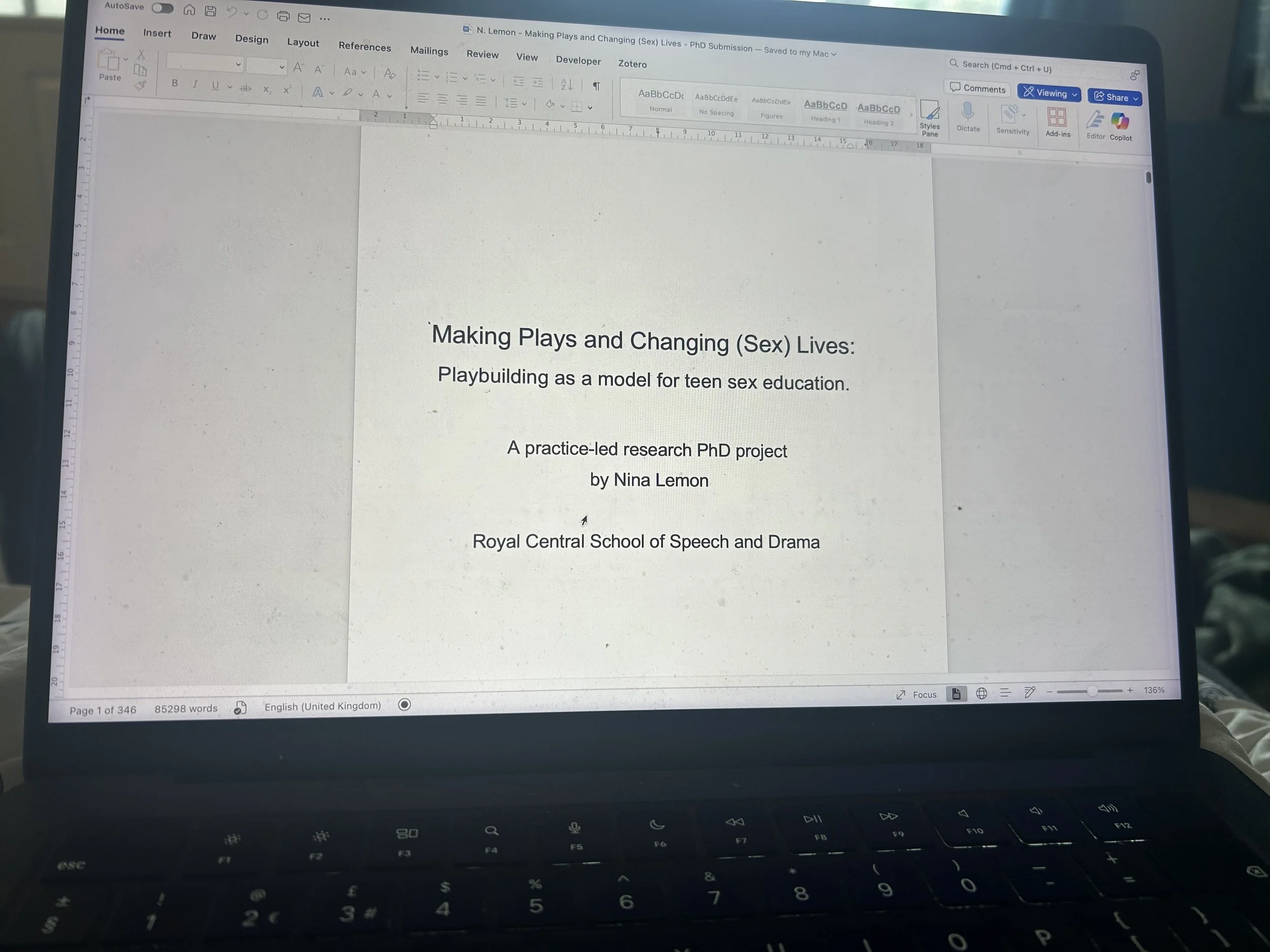
If you’re thinking about embarking on a PhD, especially in creative practice, and your life is already complicated (or you suspect your route won’t be a neat, linear one), then this snapshot of my journey might be useful.
Mine has been, let’s say, eventful.
Along the way there’s been full-time work running a fast-growing charity while studying part-time, two different universities, several supervisor changes, a life-changing accident that left me with a permanent disability, a global pandemic, discovering I wasn’t raising one but two children with severe learning disabilities, autism and challenging behaviours, losing my dad, a late-life ADHD diagnosis just as perimenopause arrived, and an international research project in India that was due to start in April 2020 and therefore never did.
That’s without mentioning the significant chunk of research that disappeared along with it.
So yes. Convoluted feels fair.
I don’t really think of myself as an academic. I’m a theatre practitioner, and what pushed me towards a PhD was curiosity, and frustration. Arts evaluation often focuses on social outcomes without really identifying the creative processes that get us there. I wanted to explore that gap.
I started my PhD in 2016, and this week I submitted my final draft, with the hope of defending in the next few months.
When I began, I didn’t imagine it would take close to ten years. I also didn’t anticipate just how much both my own life and the wider world would change in that time. Technically it’s been a decade, but when you factor in the many pauses I had to take, I’ve completed about four years of active study at my current university.
That is an achievement, even if it doesn’t always feel like one, especially as my thesis is about the work I do at Peer Productions, so my brain hasn’t really switched off from it since 2016.
Still. Eighty-five thousand words, two plays, and their digital versions later, it’s submitted.
Here are three things I’ve learned along the way, in case they’re helpful.
1. Practice-based research doesn’t necessarily mean less work
I started out naively thinking that because my thesis included creative outputs (two full-length plays - Losing It and Man Up), the written dissertation would be lighter.
It wasn’t.
Once you properly contextualise, analyse and unpick your practice, the word count quickly becomes fairly standard PhD length, on top of the creative work. If, like me, you’re working in arts for social change, you may also find yourself drawing on sociology, psychology and government policy alongside your artistic discipline. Holding all of that together takes both time and word count.
So yes, practice-based research is wonderful. But it’s not the shortcut I secretly hoped it might be.
2. Academic writing uses a completely different part of your brain
I write a lot: plays, funding applications, reports, marketing copy. Words usually come easily to me.
Academic writing does not.
It’s a different kind of thinking. Absorbing huge amounts of material, making sense of it, holding it in your head, and then shaping your own argument. With ADHD, the remembering part is particularly hard.
Add in parenting two children with additional needs, and any fantasy of a perfect writing routine disappears quickly. Most of my work happened in snatched moments: in notebooks, on my phone in the car while someone slept in the back, in the bath, between school runs and feeds. After my accident, I also had to learn to dictate when typing became too painful.
Academic writing really doesn’t love being done in fragments.
I’d often just get into a productive headspace and then have to stop. Switching back in later took time. It’s no surprise that the most intense writing happened right at the end, once my children moved into residential care and I began ADHD medication, which finally gave me longer stretches of uninterrupted thinking.
There are also rules in academic writing, even in the arts. You can break them, but usually only once you understand them. I learned most of this through supervisor feedback, which often left me feeling unsure whether what I was doing was scholarly enough or PhD-worthy.
Feeling lost is, apparently, part of the process.
3. A PhD is really about learning how to research
A doctorate is fundamentally about thinking, reading and writing.
When I started, I imagined a future portfolio career: moving away from full-time work running Peer Productions, combining part-time lecturing in higher education with creative practice at Peer, and hopefully improving my financial security in the process.
The reality has shifted.
With chronic underfunding in arts and humanities, opportunities to teach drama and theatre in higher education are now few and far between, and many posts are short-term or sessional. Over the last ten years, my (modest) arts charity salary has slowly increased, while lecturer rates have fallen. Most HE roles would now involve a drop in income rather than a boost.
I may be better placed to access research funding, which can sometimes be more generous than arts funding even in the current climate. But I won’t pretend I’m completely at peace with how limited the financial returns of a PhD are likely to be. It is hard to reconcile the level of investment involved with the lack of structural reward, particularly for people in the arts.
I didn’t begin this journey because I loved research. But somewhere along the way, I found that I do.
When I finally defend and (hopefully) gain the title, very little will change in my professional life. I am not particularly interested in attending a graduation or wearing a robe and cap. Day to day, I will still be running a charity. I will still be making theatre. But I have changed. Spending nearly a decade interrogating my own practice has made me a better artist. I think more deeply, more analytically, more holistically and ultimately more creatively.
The endurance, perseverance and resilience this process required are things I’m deeply proud of.
It’s been a long, exhausting, and expensive slog, and I’m immensely relieved to see the finish line.
Most importantly: if a middle-aged, from a working-class background, neurodivergent carer who hadn’t written an essay in over a decade can get this far, then if you’re wondering whether PhD research might be for you, it probably is.
It won’t be easy. From what I’ve learned, almost nobody’s path is linear, even if mine might be more circuitous than most. It will take time, energy, money, and a level of persistence you may not yet know you possess.
I didn’t start this journey feeling confident or prepared. I started because I had questions I couldn’t ignore. Ten years later, I’m still asking them, just with a deeper understanding of my work and myself.
If you’re drawn to research, if you’re willing to sit with uncertainty, and if you can find people who will support you along the way, it is possible. Hard. Messy. Worth it.
And if PhD research is something you’re quietly wondering about, I hope this shows that there isn’t one kind of person who gets to do it.Sometimes, you just keep going. And sometimes, that’s enough.
